Is Illinois Institute of Technology a Liberal Arts School
Coordinates: 41°fifty′4.75″N 87°37′42″W / 41.8346528°North 87.62833°W / 41.8346528; -87.62833
 | |
| Motto | Transforming Lives. Inventing the Future. |
|---|---|
| Type | Private university |
| Established | 1890 (1890) |
| Academic affiliations |
|
| Endowment | $236.9 million (2019)[one] |
| President | Raj Echambadi |
| Provost | Peter Kilpatrick[two] |
| Academic staff | 659[3] |
| Students | 7,266[4] |
| Undergraduates | 2,924[four] |
| Postgraduates | 2,996[4] |
| Doctoral students | 1,346[4] |
| Location | Chicago, Illinois U.S. |
| Campus | Urban, 120 acres (48.half dozen ha)[3] |
| Newspaper | TechNews |
| Colors | Ruby-red and gray[5] |
| Nickname | Crimson Hawks |
| Sporting affiliations | NCAA Division Three — Northern Athletics Collegiate Conference |
| Mascot | Talon the Hawk |
| Website | iit |
 | |
Illinois Institute of Technology (Illinois Tech) is a private research academy in Chicago, Illinois. Tracing its history to 1890, the present name was adopted upon the merger of the Armour Establish and Lewis Institute in 1940. The university has programs in architecture, business, communications, design, technology, industrial technology, data technology, constabulary, psychology, and science. It is classified among "R2: Doctoral Universities – High research activeness".[half dozen]
The university'south historic roots are in several 19th-century engineering science and professional education institutions in the United States. In the mid 20th century, information technology became closely associated with trends in modernist architecture through the work of its Dean of Architecture Ludwig Mies van der Rohe, who designed its campus. The Institute of Design, Chicago-Kent College of Police force, and Midwest College of Engineering were also merged into Illinois Tech.
History [edit]
The Sermon and The Plant [edit]
In 1890, when advanced pedagogy was often reserved for society's elite, Chicago minister Frank Wakely Gunsaulus delivered what came to exist known every bit the "Million Dollar Sermon." From the pulpit of his South Side church, near the site Illinois Institute of Technology now occupies, Gunsaulus said that with a million dollars he could build a school where students can learn to think in practical non theoretical terms; where they could be taught to "learn by doing."
Inspired past Gunsaulus' vision, Philip Danforth Armour, Sr. (1832–1901) gave $1 million to found the Armour Establish—and Armour, his wife, Malvina Belle Ogden Armour (1842–1927) and their son J. (Jonathan) Ogden Armour (1863–1927) continued to support the academy in its early years. Armour claimed information technology was his best paying investment.[seven] When Armour Institute opened in 1893, it offered professional person courses in applied science, chemistry, architecture and library science.[8]
Illinois Tech was created in 1940 past the merger of Armour Institute and Lewis Institute. Located on the west side of Chicago, Lewis Institute, established in 1895 past the manor of hardware merchant and investor Allen C. Lewis, offered liberal arts too as science and engineering science courses for both men and women.[ix] At carve up meetings held by their respective boards on October 26, 1939, the trustees of Armour and Lewis voted to merge the two colleges. A Cook County excursion court conclusion on April 23, 1940, solidified the merger.[10]
Mergers and changes [edit]
The Plant of Design (ID), founded in Chicago past László Moholy-Nagy in 1937, merged with Illinois Tech in 1949.[eleven]
Chicago-Kent Higher of Police force, founded in 1887, became part of the university in 1969, making Illinois Found of Engineering 1 of the few engineering-based universities with a law school.
Too in 1969, the Stuart School of Direction and Finance—now known as the Stuart School of Business – was established thank you to a gift from the estate of Lewis Institute alumnus and Chicago financier Harold Leonard Stuart. The program became the Stuart School of Business organisation in 1999.[12]
The Midwest Higher of Applied science,[13] founded in 1967, joined the university in 1986, giving Illinois Tech a presence in west suburban Wheaton with what is today known equally the Rice Campus.[fourteen]
In Dec 2006, the University Applied science Park at Illinois Institute of Technology, an incubator and life sciences/tech kickoff-upwards facility, was started in existing research buildings located on the south terminate of Mies Campus.[15] As of April 2014[update], University Tech Park at Illinois Institute of Engineering is home to many companies.
Today, Illinois Tech is a private, PhD-granting university with programs in engineering, science, man sciences, practical applied science, architecture, business, pattern, and constabulary. It is i of 23 institutions that contain the Clan of Contained Technological Universities (AITU).[16]
Growth and expansion [edit]
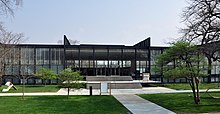
Illinois Tech connected to expand after the merger. As one of the first American universities to host a Navy V-12 program during Earth War Ii[18] the schoolhouse saw a large increase in students and expanded the Armour campus beyond its original 7 acres (2.83 ha). Two years earlier the merger, High german architect Ludwig Mies van der Rohe joined the so Armour Institute of Engineering to caput both Armour's and the Fine art Found of Chicago'due south architecture program. The Fine art Establish would later separate and course its own program. Mies was given the job of designing a completely new campus, and the result was a spacious, open, 120-acre (48.6 ha) campus set in contrast to the busy, crowded urban neighborhood effectually it. The first Mies-designed buildings were completed in the mid-1940s, and construction on what is considered the "Mies Campus" continued until the early 1970s.
Technology and research also saw corking growth and expansion from the post-war period until the early on 1970s. Illinois Tech experienced its greatest period of growth from 1952 to 1973 under President John T. Rettaliata, a fluid dynamicist whose enquiry accomplishments included work on early development of the jet engine and a seat on the National Aeronautics and Space Council. This period saw Illinois Tech equally the largest technology school in the United States, as stated in a feature in the September 1953 upshot of Popular Science mag. Illinois Tech housed many research organizations: IIT Inquiry Institute (formerly Armour Enquiry Foundation and birthplace of magnetic recording wire and tape also equally sound and video cassettes), the Constitute of Gas Technology, and the American Clan of Railroads, amidst others.
Three colleges merged with Illinois Tech later the 1940 Armor/Lewis merger: Institute of Blueprint in 1949, Chicago-Kent College of Law in 1969, and Midwest Higher of Applied science in 1986.[19] Illinois Tech'due south Stuart School of Business was founded by a gift from Lewis Institute alumnus Harold Leonard Stuart in 1969, and joined Chicago-Kent at Illinois Tech's Downtown Campus in 1992; it phased out its undergraduate program (becoming graduate-only) after jump 1995. (An undergraduate business plan focusing on engineering science and entrepreneurship was launched in fall 2004 and was for a while administratively separate from the Stuart Schoolhouse. It is now part of the school, only remains on Principal Campus.) The Plant of Design, once housed on the Mies Campus in Due south.R. Crown Hall, also phased out its undergraduate programs and moved downtown in the early 1990s.
Although not used in official communication, the nickname "Illinois Tech" has long been a favorite of students, inspiring the proper noun of the educatee newspaper; (renamed in 1928 from Armour Tech News to TechNews), and the old mascot of the university's collegiate sports teams, the Techawks. During the 1950s and 1960s, the nickname was really more prevalent than "IIT." This was reflected by the Chicago Transit Potency's Greenish Line rapid transit station at 35th and State beingness named "Tech-35th", just has since been changed to "35th-Bronzeville-IIT." In the 2010s, school administrators began a move to reintroduce the "Illinois Tech" nickname, to subtract confusion with the Indian Institutes of Technology that share the IIT abbreviation and with ITT Technical Institute whose abbreviation is similar.[xx]
In June 2020 Illinois Tech launched the College of Computing and the revamped Lewis College of Science and Messages.[21] The Higher of Calculating houses the information science, applied mathematics, and information engineering and management departments, equally well as the industrial technology and management program. The revamped Lewis Higher added the biology, chemical science, food scientific discipline and diet, and physics departments to the remaining humanities, psychology, and social science departments. With the launch of the College of Computing and revamped Lewis Higher of Science and Letters, the Schoolhouse of Applied Applied science and College of Science were dissolved.
Today [edit]
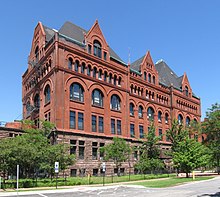
Primary Building of the Armour Found of Engineering
In 1994 the National Commission on IIT considered leaving Mies Campus and moving to the Chicago suburbs. Construction of a veritable wall of Chicago Housing Authority high-rises replaced virtually all of Illinois Tech's neighbors in the 1950s and 1960s, a well-significant but flawed attempt to improve conditions in an economically declining portion of the city. The closest high-ascension, Stateway Gardens, was located merely due south of the Illinois Tech campus boundary, the last building of which was demolished in 2006. But the Dearborn Homes to the immediate north of campus notwithstanding remain. The past decade has seen a redevelopment of Stateway Gardens into a new, mixed-income neighborhood dubbed Park Boulevard; the completion of the new central station of the Chicago Police Department a block e of the campus; and major commercial development at Roosevelt Road, just north of the campus, and residential development as close every bit Michigan Avenue on the east purlieus of the schoolhouse.
Bolstered by a $120 million souvenir in the mid-1990s from Illinois Tech alumnus Robert Pritzker, sometime chairman of IIT's board of trustees, and Robert Galvin, old chairman of the board and onetime Motorola executive, the university has benefited from a revitalization. The commencement new buildings on Mies Campus since the "completion" of the Mies Campus in the early on 1970s were finished in 2003—Rem Koolhaas's McCormick Tribune Campus Center and Helmut Jahn's Land Street Village. S. R. Crown Hall, a National Historic Landmark, saw renovation in 2005 and the renovation of Wishnick Hall was completed in 2007. Undergraduate enrollment has breached 3,000.[22] To further boost their focus on biotechnology and the melding of business and engineering science, University Engineering science Park at Illinois Tech, an expansive research park, has been developed by remodeling erstwhile Plant of Gas Applied science and enquiry buildings on the due south end of Mies Campus.
Academics [edit]
Academic units [edit]
Illinois Tech is divided into v colleges (Higher of Computing, Armour College of Engineering, Lewis College of Science and Letters, Higher of Architecture, Chicago-Kent College of Law), an establish (Institute of Blueprint), i schoolhouse (Stuart School of Business), and a number of research centers, some of which provide bookish programs independent of the other bookish units. While many maintain undergraduate programs, some only offer graduate or certificate programs.
In 2003 Illinois Tech administrators split the former Armour Higher of Engineering and Science into 2 colleges known as the Armour College of Engineering and the Higher of Science and Letters.[23] The Armour College of Engineering science is composed of five departments: the Department of Biomedical Engineering science, the Department of Biological and Chemic Engineering science, the Section of Civil, Architectural and Environmental Technology, the Department of Mechanical, Materials and Aerospace Engineering, and the Department of Computer and Electrical Engineering.[24]
In 2013, Illinois Tech administrators reorganized the College of Science and Messages and Institute of Psychology, forming the Higher of Science (Section of Applied Mathematics, the Section of Biology, the Section of Chemistry, the Department of Physics, the Section of Informatics, and the Section of Mathematics and Science Education),[25] and the Lewis Higher of Human Sciences (the Section of Humanities, the Department of Psychology, and the Department of Social Sciences).[26]
The Institute of Blueprint was founded in 1937 equally the New Bauhaus: Chicago School of Design past László Moholy-Nagy. It became known equally the Establish of Design in 1944 and later joined Illinois Constitute of Technology in 1949.[27]
Illinois Tech also contains the College of Compages. This college began in 1895 when trustees of Armour Plant and Art Institute merged the architectural programs of both schools to grade the Chicago School of Architecture of Armour Found.[28]
The School of Applied Engineering was founded as the Center for Professional Development in 2001 to provide technology oriented didactics for working professionals.[29] [30] In Dec 2009 Illinois Tech announced the formation of the School of Applied Technology, equanimous of undergraduate and graduate degree programs in Industrial Technology and Management (INTM) and Information Technology and Direction (ITM), as well as non-credit Professional Learning Programs (PLP).[31] These programs were all formerly part of the Center for Professional Evolution. Professional Learning Programs offers noncredit continuing education courses and certificates, corporate training, a Professional Engineering Examination Review program, international programs including English as a Second Linguistic communication instruction, short courses and seminars ranging from a few hours to several days in length.[32] [33] In 2014 the Department of Food Science and Nutrition was formally launched inside the School of Applied Technology, formed from degree programs originating inside Illinois Tech's Plant for Food Safe and Health (IFSH).[34] The School of Applied Engineering was dissolved in June 2020; its departments and programs remained, split between the new Higher of Calculating and Lewis College of Science and Messages.
Chicago-Kent College of Law began in 1886 with law clerks receiving tutorials from Appellate Guess Joseph Thousand. Bailey to set up for the newly instated Illinois Bar Examination. By 1888 these evening sessions adult into formal classes and the Chicago College of Constabulary was established.[35] It was not until 1969 that the schoolhouse was incorporated into Illinois Found of Technology.[27]
With a bequest from Illinois Tech alumnus and financier Harold Leonard Stuart the Stuart School of Business was established in 1969.[36] In addition to the M.B.A. and PhD, Stuart offers specialized programs in Finance, Mathematical Finance (provided in conjunction with the Illinois Tech Department of Practical Mathematics), Environmental Management and Sustainability (provided in conjunction with the Chicago-Kent College of Police force and Department of Civic, Architectural, and Ecology Technology), Marketing Analytics, and Public Administration. The PhD program in Direction Science offers specializations in Finance and Analytics.
Illinois Tech also offers many dual admission programs including programs in medicine, optometry, pharmacy, law, and business organisation.[37]
Rankings and recognition [edit]
| Academic rankings | |
|---|---|
| National | |
| Forbes [38] | 208 |
| THE/WSJ [39] | 118 |
| U.S. News & World Report [40] | 124 |
| Washington Monthly [41] | 74 |
| Global | |
| QS [42] | 426 |
| THE [43] | 301–350 |
| U.S. News & Globe Study [44] | 736 |
- Illinois Tech was featured on Princeton Review's 2014 list of 378 all-time colleges in the Usa and on its listing of Best Midwest Colleges.[45]
- Illinois Tech was ranked as a tier i academy beingness the 96th best university nationally (climbing seven places upward from the previous twelvemonth), and the third best university in the Chicago metropolitan area (later on the University of Chicago and Northwestern University), based on U.S. News & Globe Report 's "Best Colleges 2019."[22] [46]
- Illinois Tech was featured as No. 24 on Newsweek 'southward College Rankings 2012: Most Rigorous Schools list.[47]
- Illinois Tech was ranked the 72nd best graduate school for engineering science in U.S. News & World Study's "All-time Graduate Schools 2014."[48]
- Chicago-Kent was ranked every bit a tier 1 police force schoolhouse being the 68th best police school nationally (5th in Trial Advocacy, 11th in Intellectual Belongings Law, and 21st in Part-time Law) based on U.S. News & Globe Report."[22]
- According to the U.S. News & World Written report, Illinois Tech's Aerospace Engineering was ranked 21, Materials Engineering was ranked 59, Chemical Engineering was ranked 60 and Biomedical Applied science was ranked 61.[48]
- Illinois Tech was designated in 2015 as a National Center of Academic Excellence in Cyber Defence Education past the U.Due south. Department of Homeland Security and the National Security Bureau, acknowledging the substantial focus on cybersecurity and digital forensics in formal degrees, certificates, and specializations in programs offered by the College of Computing.[49] [l]
Campus System [edit]
Illinois Tech has four campuses.
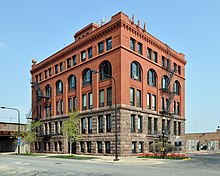
The main campus is located at 10 W 35th Street in Chicago's Bronzeville neighborhood and houses all undergraduate programs and graduate programs in engineering, sciences, architecture, communications, and psychology. The downtown campus, which was renamed the Conviser Law Centre in early 2020,[51] at 565 West Adams Street in Chicago houses Chicago-Kent College of Law, Stuart School of Business, and the graduate programs in Public Assistants. The Daniel F. and Ada L. Rice Campus in Wheaton, Illinois houses some caste programs in Information Technology and Management. This 19-acre (seven.69 ha) campus opened its doors in January 1991. Moffett Campus in Bedford Park, Illinois, is domicile to the Establish for Nutrient Safety and Health. Moffett Campus was donated to Illinois Tech past CPC International Inc. in 1988.[52]
VanderCook College of Music shares Illinois Tech'due south Chief Campus: VanderCook College of Music and offers cross-registration for Illinois Tech students.

The Paul V. Galvin Library, designed past architect Walter Netsch in 1962. It is named for the founder of Motorola.[53]
The 120-acre (48.6 ha)[54] Illinois Tech master campus, known every bit Mies Campus, is centered around 33rd and State Streets, approximately 3 miles (four.8 km) south of the Chicago Loop in the celebrated Bronzeville neighborhood on the South Side of Chicago,[55] part of the Douglas community area. Too known as the Black Metropolis District, the area is a landmark in African-American history.[56] Post-obit rapid growth during the Corking Migration of African-Americans from the southward between 1910 and 1920, it became domicile to numerous African-American owned businesses and cultural institutions and offered an culling to the race restrictions that were prevalent in the rest of the city.[56] The surface area was abode to writer Gwendolyn Brooks, civil rights activist Ida B. Wells, bandleader Louis Armstrong, pilot Bessie Coleman and many other famous African-Americans during the mid-20th century.[57] The church where Emmett Till's funeral was held is less than a mile s of the campus. The nine extant structures from the flow during the Great Migration when the area became known as the Blackness Metropolis Commune were added jointly to the National Register of Historic Places in 1986[58] and designated a Chicago Landmark in 1998.[59]
In 1941, the Chicago Housing Authority began erecting massive public housing developments in the area.[threescore] Past 1990, the Illinois Tech campus was encircled by high-rising housing projects rife with criminal offence.[61] The projects were demolished beginning in 1999,[61] and the expanse began to revitalize, with major renovations to King Drive and many of the celebrated structures and an influx of new, upscale, housing developments.[62] Neighborhood features include Guaranteed Charge per unit Field—dwelling house of the Chicago White Sox—Burnham Park, and 31st Street Embankment on the Lake Michigan waterfront, and historical buildings from the heyday of the Black Metropolis era, including the Chicago Bee Building, the Eighth Regiment Arsenal, and the Overton Hygienic Edifice. The campus is bordered on the west by the Chicago 'L' Red Line, which runs parallel to Lake Michigan northward to Rogers Park and south to 95th street. The Green Line bisects the campus and runs north to the Loop and and so west to the well-nigh w suburbs and south to the Museum Campus and the University of Chicago.[63]
Today, Illinois Tech continues to support the Historic Bronzeville area by sponsoring non-for-profits such as The Renaissance Collaborative.[64]
Architecture [edit]


The campus, roughly bounded between 31st and 35th streets, Michigan Artery, and the Dan Ryan Expressway, was designed by modernist architect Ludwig Mies van der Rohe, "1 of the great figures of 20th-century compages,"[66] who chaired the IIT School of Architecture from 1938 to 1958.[67] Van der Rohe'southward master plan for the Illinois Tech campus was one of the well-nigh ambitious projects he ever conceived and the campus, with 20 of his works, is the greatest concentration of his buildings in the globe.[68] The layout of the campus departs radically from "traditional college quadrangles and limestone buildings".[68] The materials are inspired past the factories and warehouses of Chicago's Southward Side[68] and "embod[y] 20th century methods and materials: steel and concrete frames with drapery walls of brick and glass."[69] The campus was landscaped by van der Rohe'due south close colleague at Illinois Tech, Alfred Caldwell,[seventy] "the last representative of the Prairie School of landscape architects."[71] Known as "the nature poet",[72] Caldwell's program reinforced van der Rohe's design with "landscaping planted in a gratuitous-flowing manner, which in its interaction with the pristine qualities of the architecture, introduce[d] a poetic attribute."[73]
On the west side of Mies Campus are three cherry brick buildings that were original to Armour Institute, congenital between 1891 and 1901. In 1938 Ludwig Mies van der Rohe began his 20-year tenure as director of IIT's School of Architecture (1938–1959). The university was on the verge of building a brand new campus, to be one of the nation'due south starting time federally funded urban renewal projects. Mies was given carte blanche in the big committee, and the academy grew fast enough during and afterward World War II to allow much of the new plan to exist realized. From 1943 to 1957, several new Mies buildings rose across campus, including the Due south.R. Crown Hall, which houses the compages school, and was designated a National Historic Landmark in 2001.[17]
Although Mies had emphasized his wish to complete the campus he had begun, commissions from the tardily 50s onward were given to Skidmore, Owings & Merrill (SOM), prompting Mies to never return to the campus that had inverse architecture the earth over. SOM architect Walter Netsch designed a few buildings, including the new library that Mies had wished to create, all of them similar to Mies's style. Past the late 1960s, campus add-on projects were given to SOM's Myron Goldsmith, who had worked with Mies during his education at Illinois Tech and thus was able to design several new buildings to harmonize well with the original campus. In 1976, the American Institute of Architects recognized the campus equally one of the 200 virtually significant works of architecture in the Us. The new campus center, designed past Rem Koolhaas, and a new state-of-the-art residence hall designed past Helmut Jahn, Land Street Village, opened in 2003. These were the first new buildings built on the Main Campus in 32 years. Illinois Tech opened its first new academic building in nearly xl years in October 2018, when it dedicated the Ed Kaplan Family Found for Innovation and Tech Entrepreneurship.[74]
In 1976, American Found of Architects named the Illinois Tech campus ane of the 200 most significant works of architecture in the United States.[75] Mies Campus was added to the National Register of Celebrated Places in 2005.[76]
Sustainability [edit]
In 2010 Illinois Tech received the Princeton Review's highest sustainability rating amid universities in Illinois, tied with the University of Illinois at Urbana–Champaign.[77]
Notable buildings [edit]
S. R. Crown Hall [edit]
S. R. Crown Hall, erected in 1955, was considered past Mies to be one of his greatest architectural achievements. To provide for a flexible, columnless interior, he suspended the roof from four steel girders supported by eight external columns spaced sixty feet apart. Southward. R. Crown Hall, home to Illinois Tech's College of Architecture, has been described as an "immortal contribution to the compages of Chicago and the globe." Southward. R. Crown Hall was granted National Celebrated Landmark condition in 2001. A $15 million renovation, completed in Baronial 2005, modernized the structure with free energy-saving mechanicals and windows, along with needed technology upgrades for computers and the Internet—all while carefully preserving the architectural integrity of the edifice, within and out. Additional improvements were completed in 2013.[78]
State Street Village [edit]
State Street Village (SSV), a educatee residence hall designed by Murphy/Jahn architects on the southeast corner of 33rd and State Streets just southward of the campus center, was completed in August 2003. Helmut Jahn, who studied architecture at Illinois Tech nether Mies van der Rohe in the late 1960s, is responsible for the innovative pattern of the residence hall. The construction is composed of three separate five-story buildings, joined by exterior glass walls that muffle racket from passing trains on the adjacent "L" tracks. SSV houses 367 students in apartment-style and suite-style units.
McCormick Tribune Campus Center (MTCC) [edit]
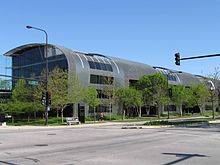
The McCormick Tribune Campus Centre (MTCC) at 33rd and State Streets opened in September 2003. Designed by Dutch architect Rem Koolhaas, considered one of the "10 almost influential living architects by the American Constitute of Architects," the campus centre arranges various areas effectually diagonal pathways, resembling interior streets, that are extensions of the paths students utilize to cross the campus. The design includes a concrete and stainless steel tube that encloses a 530-foot stretch of the Green Line elevated commuter rail ("L") tracks, passing directly over the one-story campus centre edifice. The tube dampens the sound of trains overhead every bit students enjoy nutrient courts, student arrangement offices, retail shops, a recreational facility and campus events.
Ed Kaplan Family unit Institute for Innovation and Tech Entrepreneurship [edit]

Main archway of the Kaplan Institute
The newest addition to the Mies Campus came from Chicago architect, and Higher of Architecture professor John Ronan, who was selected to design the Ed Kaplan Family Institute for Innovation and Tech Entrepreneurship.[79] Ronan's building, the first new bookish building in more than 40 years, was completed in 2018.[lxxx] In 2019, the Kaplan Center won the American Found of Architects Chicago Affiliate' south highest architectural design award.[81]
Campuses [edit]
Illinois Institute of Technology has four campuses in the Chicago area. A portion of the 120-acre Main Campus, identified as the Illinois Institute of Applied science Academic Campus, was entered onto the National Register of Historic Places in 2005.[82] The consummate 120-acre campus, also known as the Mies Campus, was designed by Ludwig Mies van der Rohe, universally considered i of the 20th century's nearly influential architects and the manager of the architecture plan at Illinois Tech from 1938 to 1958. In 1976, the American Institute of Architects recognized the Illinois Tech main campus, centered at 33rd and State Streets in Chicago, equally one of the 200 most significant works of compages in the United states. S. R. Crown Hall, habitation of Illinois Tech's College of Architecture, was named a National Celebrated Landmark in 2001.[83]
The Illinois Found of Engineering science Academic Campus undertook a series of projects with Peter Lindsay Schaudt Landscape Architecture, Inc. (now Hoerr Schaudt) in 2000 to revitalize the celebrated campus.[84] Keeping in spirit with the original design of landscape architect Alfred Caldwell (1903–1998) who worked closely with van der Rohe, the landscape architects at Peter Lindsay Schaudt played upon his concept of horizontality and favored a native institute palette.[85] The projects created cohesive formal and breezy spaces for students and faculty to relax and gather that honour the connectedness betwixt the original architecture and landscape architecture. The projects included State Street Boulevard, Crown Hall, Federal Street, State Street Village, a planting restoration for Crown Hall, the IITRI Tower Renovation, and the IIT Research Park.[86] Upon their completion in 2005, the business firm Peter Lindsay Schaudt submitted the projects as a single entry for the National ASLA design contest, winning the General Pattern Honour of Honor.[87]
The 10-story Downtown Campus at 565 W Adams Street, designed by Gerald Horn of Holabird & Root and built past Illinois Tech in 1992, is dwelling to Illinois Tech's Chicago-Kent College of Law and Plant of Design (ID), too as the downtown campus for the Stuart School of Business.[88] The Downtown Campus was renamed the Conviser Law Center in early on 2020. The Found of Pattern has re-located to the Ed Kaplan Family unit Constitute for Innovation and Tech Entrepreneurship on the Mies Campus.
The nineteen-acre Daniel F. and Ada Fifty. Rice Campus in west suburban Wheaton, designed by Solomon Cordwell Buenz & Associates, Inc. for Illinois Tech and defended in 1990,[89] offers graduate programs, upper-level undergraduate courses, and continuing professional person education.
The five-acre Moffett Campus in southwest suburban Bedford Park was designed in 1947 past Schmidt, Garden, and Erickson and was donated to Illinois Tech in 1988.[89] Information technology houses the Institute for Nutrient Safety and Wellness (IFSH), which includes the National Center for Nutrient Safety and Engineering, a unique consortium of government, industry, and academic partners.
Student life [edit]

WIIT'south studio inside the McCormick Tribune Campus Middle
There are numerous student organizations available on campus, including religious groups, academic groups, and pupil activeness groups.
Three of Illinois Tech's major student organizations serve the unabridged student body: the Student Regime Association (SGA), the Student Union Lath (UB), and TechNews. SGA is the governing student body and acts as a liaison between university assistants and the student body, serves as a forum to express student opinion, and provides certain services to educatee organizations such every bit official recognition and distribution of funds.[90] Union Board serves as the main event programming grouping and plans more than 180 on- and off-campus events for students annually. Founded in 1938 UB is responsible for the emergence of the schoolhouse spirit and booster group Crimson Fever.[91] TechNews is the campus paper and serves as a news outlet for campus interests and as some other outlet for student opinion in both a weekly paper edition and online format; it has existed since at to the lowest degree the 1930s.[92]
Illinois Tech hosts a campus radio station, WIIT, with a radio studio in The McCormick Tribune Campus Centre. WIIT was originally an AM radio station through the 1960s, using the name WIIT Radio 64.[93] Information technology was simulcast on AM 640 and stereo FM 88.nine by the end of January 1972.[94] The station was forced to change its callsign to WOUI in 1972 considering WIIT was similar to Wait (AM).[95] Subsequently the WAIT callsign was dropped,[95] the IIT station eventually returned to its original call letters, WIIT, on Feb 23, 2001.[96]
In September 2007 the academy opened a nine-hole disc golf form that weaves around the bookish buildings on Mies Campus and is the first disc golf game course to appear within the Chicago city limits.
In anticipation of the opening of The McCormick Tribune Campus Heart, the on-campus pub and bowling alley known as "The Bog" ceased operations in 2003. Nonetheless, in response to students, faculty, and staff who missed the onetime campus hangout, The Bog reopened in February 2007 and is now open up every Thursday and Friday night offering bowling, billiards, table tennis, and video games. The Bog is also home to the campus bar, which serves beer and wine, and hosts weekly events such as comedians, live bands, or karaoke nights on its stage.
In autumn 2007, the third generation of a cappella groups was formed, The TechTonics, a coed group of students. Within a year the organization expanded and now includes an all-male person grouping, the Crown Joules, and an all-female group, the 10-Chromotones. IIT A Cappella performs a variety of shows on campus as well as off campus and in the midwest. They perform shows at the end of each semester which showcase everything they have learned.[97]
Illinois Institute of Engineering science Mies (Main) Campus has an established Greek Arrangement, which consists of seven Illinois Tech fraternities (and ane VanderCook Higher of Music fraternity) and three sororities. Fraternities Pi Kappa Phi, Delta Tau Delta, Blastoff Sigma Phi, Phi Kappa Sigma, Sigma Phi Epsilon and Triangle Fraternity and sororities Kappa Phi Delta, and Blastoff Sigma Blastoff accept chapter houses on The Quad. The Omega Delta fraternity do not.
Athletics [edit]
Illinois Tech athletic teams are the Ruby Hawks. The university is a member of the Partition III level of the National Collegiate Able-bodied Association (NCAA), primarily competing in the Northern Athletics Collegiate Conference (NACC) since the 2018–19 school twelvemonth; coinciding with the programme'due south acceptance as a full NCAA Division 3 member.[98] [99]
The Crimson Hawks previously competed in the National Association of Intercollegiate Athletics (NAIA) at the Partition I level, primarily competing in the Chicagoland Collegiate Athletic Conference (CCAC) until afterward the 2012–13 season, too every bit a member of the United states of america Collegiate Athletic Association (USCAA), until the athletic program completed the transition to NCAA Partition III later on the 2017–eighteen season.
Illinois Tech competes in nineteen intercollegiate varsity sports: Men's sports include baseball, basketball game, cantankerous land, lacrosse, soccer, swimming & diving, tennis, track & field (indoor and outdoor) and volleyball; while women's sports include basketball, cross country, lacrosse, soccer, swimming & diving, tennis, rails & field (indoor and outdoor) and volleyball.
Illinois Tech discontinued its men'south and women'south basketball programs after the 2008–09 flavour,[100] simply reinstated them outset with the 2012–13 flavour. The men's basketball squad played in its first USCAA Partitioning I Championship in March 2017. Although the team lost to Concordia Alabama, the Cherry Hawks finished the season at 22–6. Illinois Tech besides has a cricket squad every bit a office of non-varsity sports level that competes in Division II of the Midwest Cricket Conference.
Notable people [edit]
Notable kinesthesia (current and former) [edit]
- Virgil Abloh, fashion designer (Creative Director for Louis Vuitton and Founder of Off-White x Nike), entrepreneur, DJ
- John Fifty. Anderson, professor of chemical engineering
- Lori Andrews, professor of law
- Wiel Arets, professor of compages
- Shlomo Argamon, professor of computer science
- Ballad Ross Barney, adjunct professor of architecture
- John F. O. Bilson, professor of finance, dean of Stuart Schoolhouse of Business
- Harry Callahan, professor of photography
- Cosmo Campoli, professor of sculpture
- Patrick Corrigan, professor of psychology
- Michael Davis, professor of philosophy
- Martin Felsen, associate professor of compages
- Lance Fortnow, dean of the College of Computing
- Susan Fromberg Schaeffer, banana professor of English
- Lois Graham, professor of mechanical engineering
- Due south. I. Hayakawa, professor of English
- Mar Hicks, associate professor of history of technology
- Fazlur Khan, offshoot professor of structural engineering
- Albert Henry Krehbiel, professor of art
- Walter McCrone, professor of microscopy and materials science
- Karl Menger, professor of mathematics
- László Moholy-Nagy, professor of blueprint
- Art Paul, designer, creator of Playboy logo
- Walter Peterhans, taught 'visual training' class for compages students
- Sonja Petrović, associate professor of applied mathematics
- Nambury S. Raju, professor of psychology
- Edward Reingold, professor of information science and practical mathematics
- Ludwig Mies van der Rohe, professor of architecture
- John Ronan, professor of architecture
- Mohammad Shahidehpour, Bodine Chair professor of electrical and calculator engineering
- Tamara Goldman Sher, professor of psychology
- Arthur Siegel, professor of photography
- Nellie Bangs Skelton, professor of pianoforte
- Abe Sklar, professor of applied mathematics
- Susan Solomon, discover the hole in ozone layer, leader in Atmospheric Chemistry, inducted in National'due south Women Hall of Fame
- Robert Bruce Tague, professor of compages
- David Tannor (born 1958), theoretical chemist, Hermann Mayer Professorial Chair in the Department of Chemical Physics at the Weizmann Institute of Science
- John Henry Waddell, professor of sculpture and fine art
Nobel laureates [edit]
- Leon Yard. Lederman, professor of physics; Nobel laureate in physics (1988); director emeritus of Fermilab; founded the Illinois Mathematics and Science Academy[101]
- Herbert A. Simon, professor of psychology; political, economic, psychological and calculator science polymath; Nobel laureate in economics (1978)[102]
- Jack Steinberger, physicist; Nobel laureate in physics (1988); studied chemical engineering at Armour Institute of Technology but his scholarship ended and he had to get out
See also [edit]
- Architecture of Chicago
- Heart on Nanotechnology and Society
- Chicago–Kent Higher of Law
- IIT Physics Department
- IIT Enquiry Plant (IITRI)
- McCormick Tribune Campus Center
References [edit]
- ^ As of June 30, 2019. "U.Southward. and Canadian 2019 NTSE Participating Institutions Listed by Fiscal Year 2019 Endowment Market Value, and Percentage Change in Market Value from FY18 to FY19 (Revised)". National Clan of Higher and University Business organization Officers and TIAA. Retrieved September 19, 2020.
- ^ "Role of the Provost – Illinois Institute of Engineering science".
- ^ a b "IIT Viewbook" (PDF). 2008. p. 64. Archived from the original (PDF) on Nov 22, 2008. Retrieved March fourteen, 2009.
- ^ a b c d "Quick Facts for Fall 2017". Illinois Institute of Technology. 2017. Archived from the original on February 2, 2018. Retrieved February i, 2018.
- ^ "Graphic Standards Manual" (PDF). Illinois Found of Applied science. Archived from the original (PDF) on September 6, 2008. Retrieved February 12, 2019.
- ^ "Carnegie Classifications Institution Lookup". carnegieclassifications.iu.edu. Heart for Postsecondary Education. Retrieved September 12, 2020.
- ^ "P. D. Armour Dead. Chicago Millionaire Yielded to Long Disease. Fever Rallied Afterwards Son's Expiry". The Republican (Laport, PA.). Jan 7, 1901. p. eight.
- ^ IIT Athenaeum/1998.186/Armour Establish of Technology Records.
- ^ IIT Archives/1998.001/Lewis Institute Records.
- ^ IIT Archives/1998.211/Board of Trustee Records/Coming together Minutes; IIT Archives/1998.212/Board of Trustee Records/Executive Committee Records.
- ^ See photo of this issue in IIT Archives/1998.199.002/Unprocessed Photographs (Box A-ii)/Folder: Serge Chermayeff: "Serge Chermayeff, Crombie Taylor, H. T. Heald signing Institute of Pattern merger agreement".
- ^ IIT Archives/1991.006.nineteen/Deceased Donor Files/Stuart (note that some materials in this drove may be restricted); 1998.033/Biographical Files/Box South/Stuart.
- ^ IIT Archives/2003.021/Midwest College of Technology Records.
- ^ IIT Archives/RG010.03.06/Daniel F and Ada 50. Rice Campus; IIT Athenaeum 1993.002/Rice Campus Drove.
- ^ IIT Archives/2006.012/Academy Applied science Park at IIT Collection.
- ^ "FOUNDING MEMBERS – AITU". Retrieved July 30, 2020.
- ^ a b "S.R. Crown Hall". National Historic Landmark summary list. National Park Service. August 7, 2001. Archived from the original on June 5, 2011. Retrieved April 22, 2010.
- ^ "About IIT NROTC : History". Chicago, Illinois: Illinois Institute of Engineering science. 2011. Retrieved September 28, 2011.
- ^ "Midwest Higher of Applied science". Illinois Institute of Technology Daniel F. and Ada L. Rice Campus. 2011. Retrieved March 26, 2011.
- ^ Zorn, Eric (August 28, 2015). "'IIT' on its way out". Chicago Tribune . Retrieved August 31, 2015.
- ^ "College of Calculating and Lewis College of Science and Letters Launch at Illinois Tech". www.iit.edu . Retrieved July 30, 2020.
- ^ a b c "Illinois Institute of Technology – Best Colleges". U.South. News & World Report. Archived from the original on August 25, 2018. Retrieved September ten, 2018.
- ^ "IIT Science and Letters – Facts most CSL". IIT. Archived from the original on May 27, 2010. Retrieved August eighteen, 2009.
- ^ "IIT Armour College of Technology". IIT. Retrieved August 18, 2009.
- ^ "IIT College of Scientific discipline – Illinois Institute of Engineering science". science.iit.edu . Retrieved December iii, 2017.
- ^ "Home – IIT Lewis College of Human being Sciences – Illinois Found of Technology". Humansciences.iit.edu . Retrieved December three, 2017.
- ^ a b Summerfield, Ballad J.; Devine, Mary Elizabeth; Levi, Anthony. "International lexicon of university histories." Taylor & Francis, 1998. page 205. ISBN i-884964-23-0.
- ^ "IIT Higher of Architecture". Iit.edu. Archived from the original on August 12, 2013. Retrieved Dec iii, 2017.
- ^ "About – IIT School of Applied Technology". Iit.edu. Archived from the original on February 13, 2014. Retrieved December 3, 2017.
- ^ "Daily Herald Electronic Athenaeum". The Daily Herald . Retrieved August 19, 2009.
- ^ "IIT Today, Dec 17, 2009". IIT. Archived from the original on June 22, 2011. Retrieved Feb 8, 2010.
- ^ "About the School of Applied Technology at IIT". IIT. Archived from the original on February ane, 2012. Retrieved December xxx, 2011.
- ^ "Professional Learning International Programs". IIT. Archived from the original on Jan two, 2012. Retrieved December thirty, 2011.
- ^ "About the Department of Food Science and Diet". IIT. Retrieved July 17, 2015.
- ^ "Chicago-Kent Higher of Police". IIT. Archived from the original on May 27, 2010. Retrieved August 19, 2009.
- ^ "IIT Stuart". IIT. Archived from the original on June iv, 2009. Retrieved August nineteen, 2009.
- ^ "Pre-Health/Pre-Med". www.iit.edu . Retrieved July thirty, 2020.
- ^ "America's Top Colleges 2021". Forbes . Retrieved September 9, 2021.
- ^ "Wall Street Journal/Times Higher Education Higher Rankings 2021". The Wall Street Periodical/Times College Education . Retrieved October 20, 2020.
- ^ "2021 All-time National University Rankings". U.S. News & Earth Report . Retrieved September 24, 2020.
- ^ "2020 National University Rankings". Washington Monthly . Retrieved August 31, 2020.
- ^ "QS World University Rankings 2022". Quacquarelli Symonds. Retrieved June 18, 2021.
- ^ "World University Rankings 2021". Times Higher Education . Retrieved September ii, 2020.
- ^ "2021 Best Global Universities Rankings". U.S. News & World Report . Retrieved October 20, 2020.
- ^ "Illinois Institute of Technology". The Princeton Review. Retrieved August 5, 2013.
- ^ "Illinois Institute of Technology". U.South. News & Earth Report. Archived from the original on March 3, 2011. Retrieved September 10, 2013.
- ^ [1] Archived August xi, 2012, at the Wayback Machine, Newsweek 'southward Most Rigorous Schools 2012.
- ^ a b "Best Graduate Schools: Illinois Establish of Applied science (Armour)". U.Due south. News & World Report . Retrieved March 12, 2013.
- ^ "IIT Named National Center of Academic Excellence in Cyber Defense Didactics". Illinois Institute of Technology. Retrieved July 17, 2015.
- ^ "Letter designating Illinois Institute of Engineering science every bit a National Center of Academic Excellence in Cyber Defense Education" (PDF). National Security Bureau. Retrieved July 17, 2015.
- ^ "Illinois Tech Names Building for Professor Richard J. Conviser". www.iit.edu . Retrieved July 30, 2020.
- ^ Institute for Food Safe and Health. "Commonsense Science. Exceptionally Practised" (PDF). Archived from the original (PDF) on July 21, 2013. Retrieved March 21, 2014.
- ^ "IIT – Inventing the Future". Illinois Found of Engineering science. Retrieved April 23, 2010.
- ^ "IIT History – Inventing the Future". Illinois Constitute of Technology. Archived from the original on May 27, 2010. Retrieved April 22, 2010.
- ^ "Visitor Data". Illinois Plant of Engineering science. Archived from the original on May viii, 2010. Retrieved April 22, 2010.
- ^ a b "Excerpt from the National Register Nomination for Chicago's Black Urban center". National Park Service. Retrieved April 22, 2010.
- ^ "Bronzeville History". Bronzeville Cultural Bout. Archived from the original on July 8, 2012. Retrieved Apr 22, 2010.
- ^ National Register of Historic Places Inventory/Nomination: Black Urban center THEMATIC NOMINATION (PDF), National Park Service, November vii, 1985, retrieved April 22, 2010
- ^ "Black Metropolis District". Metropolis of Chicago. Retrieved April 10, 2010. [ permanent expressionless link ]
- ^ Hunt, D. Bradford (2009). Blueprint for Disaster: The Unraveling of Chicago Public Housing . Chicago: University of Chicago Printing. p. 3. ISBN978-0-226-36085-0.
- ^ a b Hrya, Derek (2008). The new urban renewal: the economic transformation of Harlem and Bronzeville. Chicago: Academy of Chicago Printing. p. 89. ISBN978-0-226-36604-3.
- ^ Severinsen, Kay (May 26, 1995). "A Rebirth in Bronzeville; Housing Renovation Boom Sparks Community Spirit". Chicago Dominicus-Times. Archived from the original (subscription required) on November 4, 2012. Retrieved April 23, 2010.
- ^ Rail 'L' System Map (Map). Chicago Transit Say-so. Archived from the original on October 25, 2011. Retrieved April 23, 2010.
- ^ "Sponsors". The Renaissance Collaborative. Archived from the original on Dec iv, 2017. Retrieved December 3, 2017.
- ^ Reed, Cheryl (October 1, 2003). "IIT architect would love encore Designer of educatee middle would like to build high-ascent here". Chicago Sun-Times. Archived from the original (subscription required) on November iv, 2012. Retrieved April 23, 2010.
- ^ "Mies van der Rohe Dies at 83; Leader of Mod Compages". The New York Times. Baronial 19, 1969. Retrieved April 22, 2010.
- ^ "Bauhaus Roots at IIT: A Heritage of Innovation and Experimentation". The Mies van der Rohe Society. Archived from the original on June 11, 2010. Retrieved April 22, 2010.
- ^ a b c "Original Master Plan". The Mies van der Rohe Guild. Archived from the original on May 13, 2010. Retrieved April 22, 2010.
- ^ "Mies: The Man, The Legacy". Mies van der Rhoe Society. Archived from the original on May 27, 2010. Retrieved Apr 23, 2010.
- ^ "Alfred Caldwell". Illinois Constitute of Applied science. Archived from the original on May eighteen, 2014. Retrieved April 22, 2014.
- ^ Domer, Dennis. "The Terminal Master" (PDF). Inland Builder Mag. p. 69. Retrieved April 22, 2010.
- ^ Drell, Darienne (September 28, 1997). "Rooted in pattern; Caldwell'due south Prairie-style landscapes are thriving". Chicago Sun-Times. Archived from the original (subscription required) on Nov 4, 2012. Retrieved April 23, 2010.
- ^ Richards, J. M.; Pevsner, Nikolaus; Abrupt, Dennis (2000). The Anti-Rationalists and the Rationalists. Oxford: Architectural Place. ISBN0750648155.
- ^ Kamin, Blair. "John Ronan'south new edifice at IIT is clearly unique, thoughtful — but questions cloud its future". chicagotribune.com . Retrieved July 30, 2020.
- ^ Schweiterman, Joseph P; Caspall, Dana M; Heron, Jane (2006). The Politics of Place: A History of Zoning in Chicago. Chicago, IL: Lake Claremont Press. p. 51. ISBN1-893121-26-7.
- ^ National Register of Celebrated Places Inventory/Nomination: Illinois Plant of Technology Academic Campus (PDF), National Park Service, August 12, 2005, retrieved Apr 22, 2010
- ^ "The Princeton Review's Guide to 286 Green Colleges" (pdf). The Princeton Review. p. 76. Retrieved April 22, 2010.
- ^ IIT Athenaeum/2004.051/S. R. Crown Hall Collection-Historic Structure Study; IIT Archives/2012.028.02/Campus Building Blueprints.
- ^ IIT Athenaeum/RG010.09/Ed Kaplan Family Institute for Innovation and Tech Entrepreneurship.
- ^ Marotti, Ally. "Illinois Tech delays, downsizes new innovation edifice". Chicagotribune.com . Retrieved December 3, 2017.
- ^ Kamin, Blair (October 25, 2019). "Column: Top architecture awards go to riverfront skyscraper, U. of C.'south public policy school and IIT'due south innovation heart". Chicago Tribune . Retrieved November 6, 2019.
- ^ IIT Athenaeum/2005.018/National Register of Historic Places–IIT Bookish Campus Nomination.
- ^ IIT Athenaeum/2001.042/Southward. R. Crown Hall Collection.
- ^ "Illinois Institute of Technology". Hoerr Schaudt. Archived from the original on August 7, 2020. Retrieved December 3, 2018.
- ^ "ASLA 2005 Professional person Awards". www.asla.org . Retrieved December 3, 2018.
- ^ "ASLA 2005 Professional Awards". www.asla.org . Retrieved December 3, 2018.
- ^ "ASLA 2005 Professional Awards". www.asla.org . Retrieved Dec three, 2018.
- ^ "Campus Locations | Illinois Institute of Technology". web.iit.edu . Retrieved Apr 2, 2017.
- ^ a b IIT Athenaeum/1999.017/Function of Public Data-Mary Dawson Papers.
- ^ "IIT Student Government Association (SGA)". Retrieved July 17, 2009.
- ^ "IIT Student Union Board (UB)". Archived from the original on September 26, 2009. Retrieved July 17, 2009.
- ^ "IIT TechNews". Retrieved July 17, 2009.
- ^ Bellinger, Steve. "Your Memories". Chicago: Illinois Institute of Technology. Retrieved May 16, 2015.
One of my favorite memories was hosting my own program on WIIT Radio 64. I was there when it went FM...
- ^ "Announcements" (PDF). Engineering News. Vol. 91, no. two. Chicago: Illinois Institute of Technology. January 28, 1972. p. 4. Archived from the original (PDF) on March 4, 2016. Retrieved May 16, 2015.
Tune in 7-12pm WIIT 640 AM, 88.9 FM (stereo).
- ^ a b Gannavarapu, Bhargava (April two, 2001). "Where Has WOUI Gone?" (PDF). TechNews. Vol. 150, no. 9. Chicago: Illinois Plant of Technology. pp. 1, 3. Archived from the original (PDF) on November 23, 2015. Retrieved May 16, 2015.
- ^ "Call Sign History". Washington, D.C.: Federal Communications Commission. Retrieved May 16, 2015.
- ^ Shaughnessy, Ciaran (May half dozen, 2008). "A Cappella Back at IIT". TechNews. Retrieved March 12, 2009.
- ^ "Illinois Tech to Join NCAA Division Iii This Fall". ILLINOIS TECH MEDIAROOM. Illinois Institute of Technology. Retrieved October four, 2018.
- ^ "Illinois Tech Joins Northern Athletics Collegiate Briefing". ILLINOIS TECH ATHLETICS. Illinois Institute of Technology. Retrieved May 5, 2017.
- ^ Olkon, Sara (March 26, 2009). "IIT shuts down basketball program". Chicago Breaking News Heart . Retrieved April thirteen, 2009.
- ^ Lederman, Leon M. (1988). Frängsmyr, Tore; Ekspång, Gösta (eds.). "The Nobel Prize in Physics 1988: Leon M. Lederman, Melvin Schwartz, Jack Steinberger". Nobel Lectures, Physics 1981–1990. Singapore: World Scientific Publishing Co. Retrieved May 22, 2012.
- ^ Simon, Herbert A. (1978). Assar Lindbeck (ed.). Nobel Lectures, Economics 1969–1980. Singapore: World Scientific Publishing Co. Retrieved May 22, 2012.
External links [edit]
- Official website
- Official athletics website
- Finding assistance for the IIT – New Campus Eye Contest fonds, Canadian Heart for Architecture.
Source: https://en.wikipedia.org/wiki/Illinois_Institute_of_Technology
0 Response to "Is Illinois Institute of Technology a Liberal Arts School"
Post a Comment